Martinus: From Freefall to a Profit Engine

Tomas Komarek
March 31. 2026

From −60% YoY Decline
to Sustainable Profit Growth
COMPANY

Industry
E-commerce
Collab
5+ years
Stage
€30-100M revenue
Tomáš is constantly testing new ideas that accelerate our profit. The big benefit is his overlapping knowledge from search ads to SEO, websites analytics and PPC automatization especially. Within the season he managed to double the revenues keeping the same ROAS.

Jan Keselak
Marketing manager at Martinus
Situation
Paid media revenue was declining up to −60% YoY, and no one knew why.
Goal
Stabilize revenue fast — without sacrificing profitability.
Results
- From −60% YoY decline to +16% revenue growth in the first year
- Up to +600% increase in profit over the following 3 years
- Paid media shifted to profit-driven optimization
Six Years Inside a System That Had to Be Understood Before It Could Be Fixed
The Situation
It started quietly.
Revenue slipped by roughly 20% YoY. Then 40%. Then 50. Then almost 60%. Month by month, the decline accelerated — right before peak season.
Martinus’ Czech business relied heavily on PPC. The agency reacted in the usual way: loosen ROAS targets, spend more, chase volume.
But revenue didn’t recover.
Cash started burning faster.
That’s when I joined — end of October 2017 —with clear goal. Stop the freefall and save the peak season.
Seeing What Others Missed
At first glance, performance had looked fine. The revenue quietly eroded. Nothing dramatic. Just enough to mislead. To start looking elsewhere:
- Products are too expensive
- Landing pages aren’t good enough
- The market is saturated
But the pattern didn’t fit.
Once I separated retention from new customer acquisition, the real problem surfaced.
Smart bidding had optimized itself into a corner — pushing more and more budget into retargeting and bottom-funnel queries. It was harvesting existing demand, not creating new one.
ROAS masked the damage.
Revenue paid the price.
Regaining Control
The first real decision was uncomfortable. Turning smart bidding off.
Not because automation is bad — but because you can’t debug what you don’t control.
Campaigns were rebuilt around query intent, not categories. Reporting was restructured so I could see performance across many layers.
With control restored, decisions became obvious.
- Waste was cut fast.
- Growth drivers were scaled aggressively.
Within weeks, the decline stopped.
By the end of the year:
- The freefall was reversed
- +16% YoY growth was recovered
- The strongest month delivered +65% YoY growth
- ROAS improved instead of collapsing

The season was saved.
Curiosity Beats Comfort
The account had more than 500 conversions per month.
Smart bidding should have worked well.
So why didn’t it?
Instead of moving on, I tested.
In 2018, I began running controlled experiments.
First, the rule-based bidding logic vs smart bidding
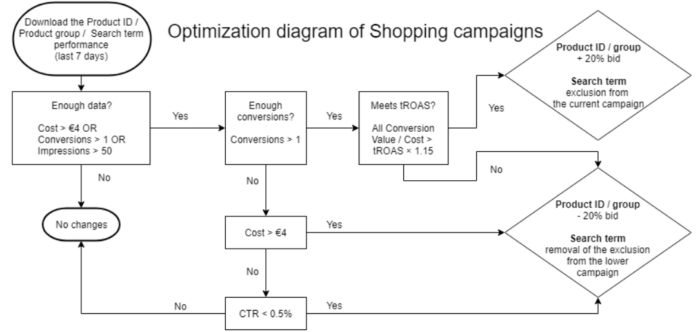
The result: My bidding logic beat the smart bidding
The work became part of my academic thesis and was later presented at PPC Date conference – see slides here. (Thanks Matouš Ledvina, Google analyst to validate the smart bidding setup and professor Stříteský for validating the results with academic accuracy.)
Second, on structure alone.
What are the variables/inputs I could use to improve my bidding logic.
The best predictor for conversion rate? – Competitiveness
Competitiveness – Our price compared to the market average. Hard to get, but I used a few app scripts to get the scraped price comparison data into the feed. It predicted conversions far more reliably than discounts. So products with small discount but when competitors did not discount at all often outperformed discounted items that were still overpriced compared to competitors.
Yet it pushed the discounted products more.
Which means less margin. And Revenue and ROAS are not the real goal.
Profit was.
I split the products by margin level, not category. Exact margins weren’t available, so approximations were built using category data, discounts, and historical performance.
Accuracy was ~70%.
Good enough.
Low-margin products had strict bidding rules while high-margin products were allowed to scale.
The business results by the end of 2018:
- +22% YoY revenue
- +34% YoY ROAS
- Significantly higher profit
Making Profit the Signal
Margins were calculated weeks after the click. Perfect data wasn’t coming.
So we were building and adjusting something imperfect – a system that would replace revenue with gross margin as the primary conversion.
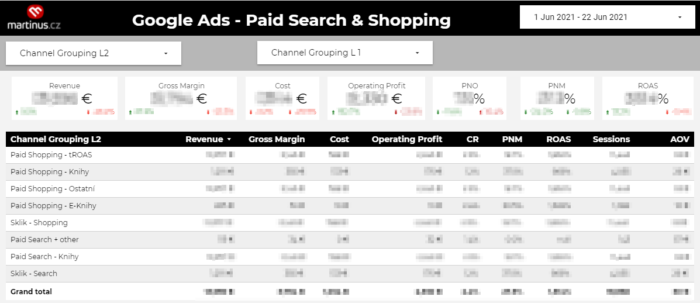
With the Martinus team — especially Martin Kružík — margin data was sent from CRM to Google Analytics via Measurement Protocol, then imported into Google Ads.
Manual bidding rules evolved as accuracy improved.
And it was a breakthrough year. Revenue dropped by 11%.
But Profit exploded.
- +600% in the Czech Republic
- +70% in Slovakia
Imperfect margin data beat perfect revenue data.
Profit Generator 2.0
By 2020–2021, margins flowed directly into Google Ads via offline conversions. Click IDs were reused across platforms. Pricing and bidding became profitability-driven.
The system was finally complex enough that smart bidding worked — and outperformed even my best rule-based setups.
To be honest, the margins sent to Google Ads were were still messy:
Why This Worked
This story isn’t about Google Ads.
It’s about how you think when systems fail.
Break them apart.
Understand the constraints.
Feed them better signals.
Move faster. Don’t wait for perfection solutions.
Accept that most experiments fail.
The ones that work pay for everything.
That’s why I love this work.
Not because of the wins —
but because every day there’s another system waiting to be understood, and pushed just a little closer to the goal.
GET INSPIRED
Case studies to guide you

Sanity.io: From Seed to $85M in Series C
Are you a B2B SaaS marketer drowning in sky-high CPCs and channels that don’t convert? Sanity felt the same pressure early on. Today, they’re a category leader with a global enterprise customer base. Part 1: EARLY-STAGE GROWTH Search was bleeding money. Users didn’t stay. Growth stalled. The Challenge Sanity just founded and faced brutal competition: Adobe. Salesforce. Contentful […]

Deepnote: How I Cut CAC by 72% and 2.5×’d Paying Customers
Unprofitable paid channels? or CAC too high?Deepnote was right there — and they needed paid to start paying back fast. After taking over their paid acquisition, the turnaround came quickly:72% lower CAC while growing above the plan: 158% more paying customers from paid in the first year only. Approach Learning from the Past The first […]

Rouvy: 20% Lower CPA in 30 Days Without Reducing Volume
Do you run paid acquisition with a senior in-house team and still ask:“What can we realistically improve — even by a few percent?” When you’re spending seven figures on media, a “small” improvement can mean hundreds of thousands in incremental revenue. That was exactly Rouvy’s situation. They didn’t expect breakthroughs — just marginal gains. What happened instead? The […]