iPrice: Engineering PPC Automation at Massive Scale

Tomas Komarek
February 28. 2026

5+ billion products
across 7 markets
COMPANY
Industry
Meta-search platform
Collab
6 months
Stage
Series B
Great experience! Tomas has outstanding technical abilities, know-how, productivity and work ethics. He adopted immediately in completely different culture of Southeast Asia.

Matteo Sutto
CMO at iPrice
Situation
iPrice operated across 7 markets with 5+ billion products, relying entirely on SEO with no paid acquisition.
Goal
Validate PPC profitability by building campaign automation directly into iPrice’s infrastructure, avoiding external tooling.
Results
- In-house PPC automation with zero additional infrastructure
- Running PPC campaigns across 7 countries in 6 months
- Improved tracking, attribution, and feed SEO through PPC experiments
The “Impossible” Problem
iPrice had already built massive success through organic traffic alone.
But when it came to paid search, agencies delivered a blunt verdict:
To promote a business this large, you’ll need $100k–$200k just for tooling.
That budget wasn’t acceptable—especially just to test whether PPC could even work.
The real challenge wasn’t ads.
It was setup in low-cost mode and later attribution, and economics.
- 5+ billion products with a constantly changing portfolio
- 7 markets: Malaysia, Indonesia, Singapore, Thailand, Vietnam, Philippines, Hong Kong
- Affiliate-based revenue with 30+ day conversion lag
- Heavy ad-blocking across APAC → Google Analytics was unreliable
Most teams would stop here.
An Automated PPC Engine
Within 6 months, I had:
🎖 A fully automated campaign builder running across all 7 countries
🎖 Profit conversion goals maintained automatically, without enterprise tooling
🎖 Improved attribution and tracking leaks fixed across the entire business
🎖 SEO performance improved using SEM learnings
And all of it was built with an agile, test-first approach.
How I Did It
1. Building the Infrastructure (Without Fancy Tools)
Instead of buying expensive platforms, I built what was actually needed:
- Automated campaign and ad group generation
- Dynamic structure based on daily product changes
- Scalable across 7 countries
- Designed to optimize for revenue and revenue, not just clicks
The system was built to adapt, not over-engineer.
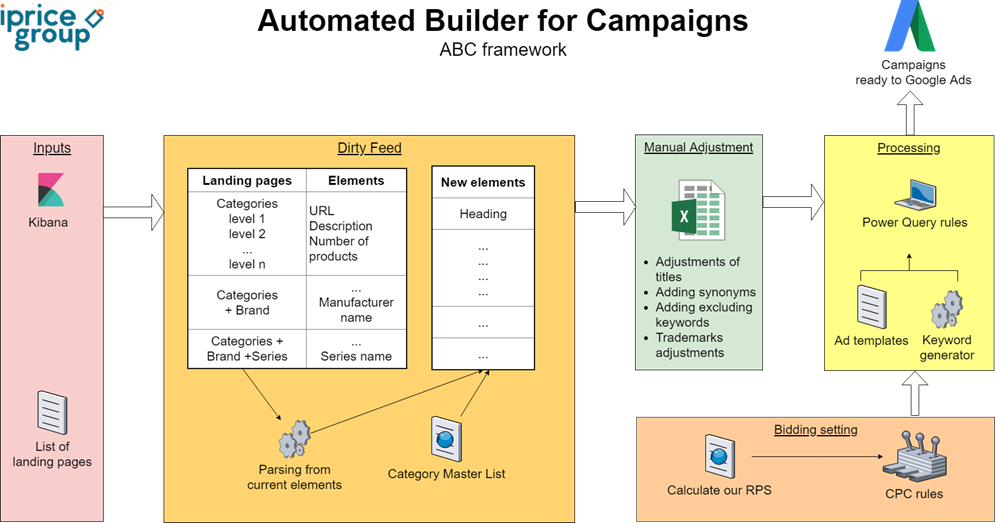
Since product feed was not available, I used the Kibana landing page exports and created my own “dirty feed”. Scraper enhanced it with extra details from the category pages (like number of products, cheapest item, biggest discount etc.)
The second input was ad builder from a template and keyword generator. The ad template builder was later used in SEO to test what variation drives higher CTR and later revenue per session.
All of the inputs were processed in Power Query where I imported the results directly to Google Ads.
2. Attribution Built for Reality (Not Theory)
Getting the right conversion inputs is as important as the right structure and setup. First, I started with importing the revenue data on session level via measurement protocol to Google Analytics. But I faced two issues:
First, hitting 10 million hits per property per month.
Second, heavy ad-blocking across APAC → Google Analytics was unreliable
What I implemented instead:
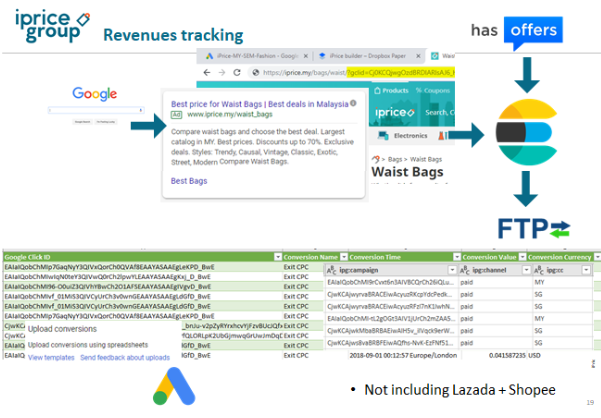
- ElasticSearch-based attribution from logs (more reliable than GA in ad-blocked regions)
- Exit-click tracking exported from Kibana
- Click IDs merged with:
- Affiliate transaction files (HasOffers, WTF, CJ, etc.)
- Stored traffic sources (GCLID)
- Revenue imported directly into Google Ads
This uncovered tracking issues across all channels, not just PPC.
Result: The business stopped losing money from misattributed traffic—company-wide.
- Extrapolated RPS per exit click, calculated using:
- Historical subcategory RPS
- Merchant-level CR
- AOV × commission rate
- Data loaded into Power BI
- Subcategory-level optimization using:
- tCPA (exit clicks generate volume easily)
This turned delayed, messy revenue into actionable bidding signals.
Results (6 Months)
- Automated PPC campaigns across 7 countries
- Scalable system handling 5+ billion products
- No enterprise-level tooling required
- Tracking fixed across all acquisition channels
Bonus: SEO uplift driven by SEM insights
The entire SEM evaluation framework was later presented at PPCEE (Central Europe’s largest PPC conference), showing how paid search insights can systematically improve SEO.
GET INSPIRED
Case studies to guide you

Sanity.io: From Seed to $85M in Series C
Are you a B2B SaaS marketer drowning in sky-high CPCs and channels that don’t convert? Sanity felt the same pressure early on. Today, they’re a category leader with a global enterprise customer base. Part 1: EARLY-STAGE GROWTH Search was bleeding money. Users didn’t stay. Growth stalled. The Challenge Sanity just founded and faced brutal competition: Adobe. Salesforce. Contentful […]

Deepnote: How I Cut CAC by 72% and 2.5×’d Paying Customers
Unprofitable paid channels? or CAC too high?Deepnote was right there — and they needed paid to start paying back fast. After taking over their paid acquisition, the turnaround came quickly:72% lower CAC while growing above the plan: 158% more paying customers from paid in the first year only. Approach Learning from the Past The first […]

Rouvy: 20% Lower CPA in 30 Days Without Reducing Volume
Do you run paid acquisition with a senior in-house team and still ask:“What can we realistically improve — even by a few percent?” When you’re spending seven figures on media, a “small” improvement can mean hundreds of thousands in incremental revenue. That was exactly Rouvy’s situation. They didn’t expect breakthroughs — just marginal gains. What happened instead? The […]